Why Am I Here?
1. Introduction
Why am I here? The question has become a philosophical cliché. What is the meaning of life? What is the point of it all? Why am I here? I once saw this cliché used to good effect in a New Yorker cartoon. A bunch of bearded philosophy professors stand in the old building where their department is housed—next to the gleaming building that houses other, more lucrative departments. Thought bubbles above their heads ask the perennial question: why are we here? This has become funnier to me in recent weeks as I contend with the asbestos under my office carpet in the basement of Armstrong Hall.
When I was a first-year graduate student I was a teaching assistant to a brilliant and prestigious philosophy professor. The course was an introduction to the subject. On the first day he projected onto the board an image of a bearded man with a thought bubble above his head that read: Why am I here? “This,” said the professor with obvious contempt, “is not what we do in philosophy.” I was confused. As a young philosopher, I thought that’s exactly what we do in philosophy, or at least what we should be doing. But I said nothing. Like all graduate students, I learned to shut up. The course mattered—we drew precise distinctions between concepts, we detected common fallacies, we analyzed the arguments of Plato—but we never asked why we were there.
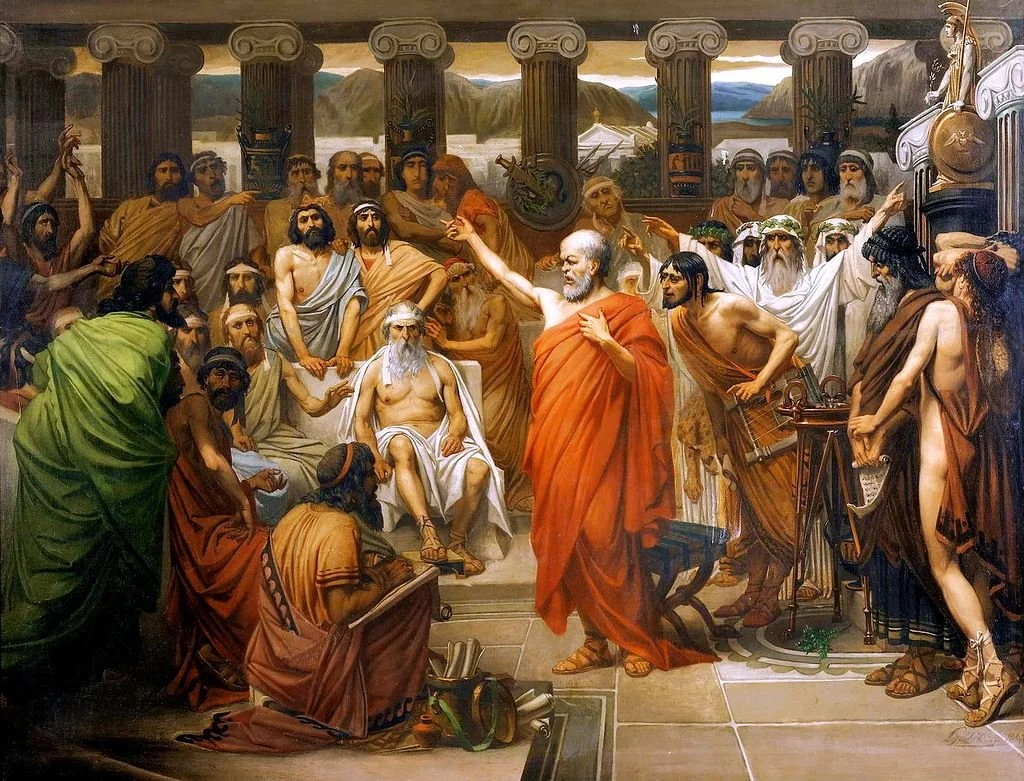
When I entered the profession, I learned the difference between being a philosophy professor and being a philosopher. It has everything to do with the question why am I here? Socrates asks it in the hour before his death, when the Athenians have condemned him to die on two charges. First, impiety: he doesn’t believe in the gods of the city, but instead in other, strange gods. Second, his teaching corrupts the youth. He’s in jail awaiting his sentence: death by suicide. But he might easily escape and save his life. His jailer is obviously sympathetic, and he has rich friends (notably Plato) who would readily pay the bribe. If it were up to flesh and bones, he jokes, he would long ago have fled to Megara. Why, then, is he here?
The dialogues in which we learn his answer are well known, or at least used to be: Euthyphro, Apology, Crito, Phaedo. We teach them every year. They’re a perfect introduction to the subject, and the Euthyphro was the first text in that first course I TA’d thirty years ago. They tell a continuous story, of a brave philosopher who interrogates the myths of his city and pays the highest price. It’s an inspiring story and has since become the founding myth of Western philosophy. This was surely Plato’s intention. When we philosophy professors teach it, accordingly, our implicit message is that this is how it began.
By “it” I mean what we are doing now—in this beautiful room, in classrooms wherever philosophy is taught. It’s all downstream from Socrates. Why are we here? To do this, what Socrates did. Even that brilliant and prestigious professor of mine would have agreed. But we differ. In his estimation what Socrates did was draw precise distinctions between concepts, expose common fallacies, and analyze arguments. I agree that this was an important part of what he did, but it was far from the whole. Nobody has ever been executed for analyzing arguments. If that’s all we’re doing in philosophy classrooms, if that’s why we’re here, then we might be doing something valuable, but we’re not doing what Socrates did.
So if we present ourselves as doing what Socrates did we’re deceiving our students. And if we don’t recognize this deception, but think we’re doing what Socrates did, then it’s also a self-deception. I think that’s usually the case. Indeed, I think the profession of philosophy is just such a tangled skein of deception and self-deception. A part of what Socrates did is presented to students as if it were the whole. An appearance of philosophy is presented as if it were real. We clothe ourselves in the shining armor of philosophy without having to risk it on the battlefield.
Plato forgives us. Even as he founded our discipline, he foresaw that it would have to be this way.
In his Republic he describes the selection and training of real philosophers. They are set apart. Above all, they must be chosen from among the most distinguished warriors. Go to a philosophy conference nowadays and you might think many things about the participants, but you will never mistake them for a band of warriors. So, what was Plato thinking? One of them is easy to appreciate immediately. Socrates was ostracized, imprisoned, and killed for what he did. Whatever he did, then, it required courage. Warriors will have that virtue. If a profession arises to imitate Socrates, but is not populated by warriors, it will not do what he did. Maybe a part, but not the whole; an appearance, but not the reality.
So what is it to really do what Socrates did? People are ostracized, imprisoned, or killed every day by their state and society, but that does not make them philosophers. Rejection is a necessary condition of philosophy, but not sufficient. The rejection has to happen for a precise reason. I contend that it must happen because the person not only asks “Why am I here?” but also has the courage to answer it truthfully.
For better or worse, I will not do that today. I am not a warrior. Nor am I a philosopher. I’m merely a philosophy professor. I’m the tanner in one of Plato’s comical little allegories. The maiden Wisdom has lost her dowry. None of the noblemen will wed her. A tanner thinks he has a chance. He takes a bath and puts on his best shoes. That’s me. I am not going to do what Socrates did. Instead, I’m going to consider aloud what it would look like nowadays if some nobleman were to do that.
2. A Secular Age
No philosopher is executed for impiety nowadays because there are not supposed to be any “gods of the city.” Everyone is free to worship whichever god he prefers. That’s the founding myth of the United States: liberalism, freedom of religion, the First Amendment. To the extent that the USA has been the hegemon of Europe, the Anglosphere, and Japan since World War Two, this has also become an integral part of the founding myth of the modern West. Whether in West Virginia or Western Queensland, you may worship whichever god you choose, or none at all. Jesus, Allah, it’s up to you. You may even worship Athena, but no one does. She’s dead. The proof of that is that you can say whatever you like about her and no one cares. Not so in ancient Athens, when Socrates was executed for asking awkward questions. But nowadays you can blaspheme her all you want.
But in this regard is Jesus any different? Well, there are no universities dedicated to Athena, but there are many Christian universities. It would seem, therefore, that Jesus is a living god. Most of the Ivies were Christian not that long ago. But they have gone secular. There are still many denominational colleges across the country. The Catholic universities are the most numerous, and I taught at one for twenty years. As recently as the 1940’s, Duquesne University of the Holy Ghost would fire professors who blasphemed—even in their personal lives, never mind on campus. Nowadays, though, Duquesne professors can (and do) say in the classroom—even the theology classroom—whatever they wish about Jesus and the Church. In this way, then, Jesus is as dead as Athena.
I’m not picking on Jesus. It’s like this with all the old, personal gods in the modern West. Were someone to have fallen asleep in the early 17th century only to wake up now in the 21st, he would of course be amazed first at our technology. Next he would marvel at our unprecedented social arrangements: women in the workplace, races mixed together, and so on. But what would impress him most deeply, I think, would be that no one in the modern West is ostracized, imprisoned, or killed when he blasphemes against Jesus,. There has never been such a society in the West. Not in his time, or in any other he could have read about before the 19th century. We live in a secular age.
Secular, but far from irreligious. We live in fear of new gods. Against them, we dare not think a contrary thought, let alone utter a contrary word or perform a contrary deed. Our devotion to them is so total that we don’t think of it as religious. We think of it, if we notice it at all, as living in the truth. This is the hallmark of a real religion. Consider the early Christians. They didn’t think of themselves as having one religion among many. Instead, they thought of themselves as living in the Truth. When people have a real religion, they do not tolerate dissenters as simply those who subscribe to a different religion, or no religion at all. They see them as superstitious, idolaters, heretics, and blasphemers. They must be deficient in character or intellect: evil, or possessed by a demon; ignorant, or insane. This is how you’re seen nowadays if you don’t worship the new gods of our city.
God is dead, said Friedrich Nietzsche. Everyone’s heard that. It’s a cliché, like the question of my title. But again, behind every cliché there is a profound truth. Nietzsche informed us that God is dead not so that he could dance on His grave, but so that he could help us see the new gods growing from the soil nourished by His corpse. This insight required a philosopher because these gods are unlike any others who have ever lived. They are impersonal. With him, we might call them not gods but “ideals.” To say with Nietzsche that we live in the most religious age ever, then, is to say we are more in the grip of ideals than any society has ever been. His Genealogy of Morality is a long story about the one super-ideal that animates them all. He calls this the “ascetic ideal.” Although it arose earlier in the East, in the Vedas, it flourished in the West. Since its arrival here, in the persons of Plato and St. Paul, it has defined Western civilization—for better and worse.
3. The Ascetic Ideal
This ideal was humanity’s first effort to give a meaning to life, that is, to everyone’s life, to the whole of life, indeed to the whole world. As such, it was a mixed blessing. We need a meaning for life because we suffer and need to know why. Those are inescapable facts. But this first stab at a meaning was always doomed because it was false, tailored not to reality as it is but to a flaw in human nature. We suffer, to be sure, but in order to find meaning in that suffering the ascetic ideal blamed us for it, thereby making it worse.
Our earliest ancestors became aware—in a way that animals are not—of the passage of time. With a mix of regret and nostalgia over the past, not to mention dread for a future that would kill them, these ancestors felt impotent before the whole world. This impotence bred resentment towards life itself. The proper remedy for this resentment, according to Nietzsche, would have been a correct understanding of time: the eternal return of the same. That’s a complicated subject that would distract us today. It’s nevertheless good to acknowledge that Nietzsche is not a nihilist who stands mute before human suffering. He has an answer, albeit one that is dismissed even by his fans. I will return to this answer in my conclusion.
To appreciate it, we must begin by understanding what has gone wrong with the answer of the ascetic ideal. To regain a sense of power over time, ascetics—whether Plato or St. Paul—imagined an eternity where it stands still. We were condemned to this life in time because we were guilty of something, some sin against the world. Christian priests taught the masses a concrete story of the original sin of Adam and Eve in the Garden, after Platonic philosophers taught elites the abstract account of the Soul’s fall from the One into fragmented time. Both taught us to see ourselves as fallen creatures, responsible for our own suffering. We acquired a guilty conscience.
This was a fresh pain, a vivisection of the soul unknown to earlier ages, but it promised to relieve our impotence and resentment. Now we could do something to remedy our suffering. Or so it seemed.
Whether you accepted Christ or became a Socratic philosopher, there was now a path to salvation. In this way, the ascetic ideal gave a meaning to life in the West. When Socrates asked himself “Why am I here?” there was an answer. “Although my bones would rather be in Megara,” he was arguing, “I am an immortal soul. I am here to testify to the truth of eternity. I am here to save myself and my disciples from the allure of bodily pleasures. I am here because this is the meaning of life.” So too at the Crucifixion. When Jesus asked himself “Why hast thou forsaken me?” there was an answer. “Although my humanity has been crushed by the torture and abandonment,” he was crying out, “I am the Son of God, here to testify to His love. I am here to redeem you from enslavement to Satan and his worldly promises. I am here to shepherd you to heaven with my Father. I am the Truth, the Way, and the Life.”
This ascetic ideal animated the great achievements of the West. From Augustine to Rafael, from architecture to science, it was all for the glory of God, or at least for the sake of the Truth, which were the same thing in any case. These achievements, and how this ideal motivated them, is a very long story for another occasion. One purpose of the Washington Center is to tell the many chapters of that story. Today I want to focus instead on Nietzsche’s argument that this ideal—however it manifested—was doomed to undermine itself. Its relentless pursuit of truth would eventually discredit the dogmas and institutions which maintained it. Whether it was Galileo in the 17th century or Darwin in the 19th, the pursuit of truth that was rooted in this ideal spilled out of the laboratories, universities, and salons into the streets and battlefields, where revolutions toppled one throne or altar after another.
The result was our secular and democratic age. The ancient versions of the ascetic ideal, which underwrote cosmic and political hierarchies, could not survive these revolutions in thought and power. Yet the need for the ideal would nonetheless persist. Geocentrism and Genesis had lost their credibility, but Westerners continued to suffer and crave an explanation for their suffering. Their old God was dead, but the ideal which had given meaning to their lives would not go quietly. Not immediately, anyway. To adapt the ascetic ideal had to generate a new type of god, one acceptable to science and democracy. In the 19th century, on cue, science and democracy mated to produce it. Karl Marx was one of its midwives, using quasi-scientific premises to promote an egalitarian utopia. But whether it came under the name of socialism, liberalism, feminism, or the replacement of war by international courts of arbitration, Nietzsche saw the same god: equality.
4. The City’s New Gods
The modern West is no less religious than the pre-secular, ancient West. In fact, it is more religious than it has ever been. It is arguably the most religious society in the history of the world. No civilization has been more devoted to the ascetic ideal than ours in the last two centuries. In the first of them, we conquered most of the globe and united it in a universal system of trade and communication. In this phase we felt no shame about our empires. We boasted of them and imposed Christianity on the conquered peoples with missionary zeal. In the second of these two centuries, however, European powers began to feel guilty.
When they didn’t retreat willingly, they were pushed out by revolutions, funded, supplied, and sometimes manned either by the USA or the USSR. Think Vietnam, think Angola, think a dozen other revolutions across the Third World between the end of World War Two and the end of the Cold War.
For although we pretended to be anti-imperial, neither the US or Russia was ashamed to impose its values. On one side of this rivalry were the socialists, who wanted to take the direct route to the egalitarian utopia, by violent revolution if need be. On the other side—the American side—were the liberals, patient enough to let the arc of history bend toward justice. The goal was the same, achieved indirectly through human rights and the “rules-based international order.” Overtly imperial Christian missions were out. Anti-imperial imposition of our ideal was in. The US State Department had a desk to manage every country’s affairs. What couldn’t be accomplished by open diplomacy could be achieved covertly by the CIA, USAID, and their dozens of NGO cut-outs. Our empire pretends not to be an Empire, just as our god pretends not to be a God.
In the new world order, animated by the ascetic ideal’s new god, it is bad to be an empire, and bad to impose your religion on others. But this ideal seeks power. That is why it emerged in the first place. Supreme power is achieved through empires imposing their will on others. So how does the ascetic ideal square this circle? How has it sought peace by provoking war after war? How has it achieved justice by forcing everyone, even foreign heads-of-state, to stand trial in its courts? How has it promoted freedom and safety by making everyone stay inside and take an experimental vaccine? How has it celebrated equality by vilifying and discriminating against white men?[1] Not by encouraging free speech, to be sure.[2] Nor by rewarding anyone who mentions these contradictions. And certainly not by creating institutions—such as the Washington Center—where they will be exposed.
I want to dwell on one such contradiction for a moment, one that marked a turning point for me, exemplifying where we are and why I am here. Remember the social distancing requirements of spring 2020—so stringent that people were forbidden from visiting their dying relatives, attending funerals, or indeed any religious service whatsoever? The public health scientists were telling the priests what to do. With Nietzsche’s help, I began to see why. The gods of the priests were dead; scientists and professors had replaced them as acolytes of the living god. For when George Floyd died, those same scientists said it was okay, even good, to march with thousands of people in the street to protest racism. They didn’t say it was against public health but that protesting racism was more important at that moment. That would have been a judgment call. Disputable, but intelligible. But no. They said protesting racism was a matter of public health. “The Science,” as it was called, locked arms with the fight for equality.
This is exactly what Nietzsche foresaw. Whether you took a knee for St. Floyd, wore masks like a hairshirt, or went out of your way to recycle that one bottle, you were seeking relief from a guilt that has grown ever sharper as the new dispensation has taken shape. There are a hundred new rituals to manage this guilt: land acknowledgments, proliferating pronouns, flags with ever more stripes. Do you know where you are on the oppression stack, or the color-wheel of intersectionality? Have you been a good ally? Have you taken a seat? Did you put up a Black Lives Matter sign? Have you refreshed it every season, or have you let it wilt over the years. Worse: have you taken it down? Does that mean Black Lives don’t Matter any longer? Maybe you posted a black square in your bio? Did you replace it with the blue and yellow? Or should it now be simply blue? So hard to decide. Have you checked your carbon-emissions? Bought cardboard straws, if you’re poor; a hybrid car, if you’re rich? Switched to impossible burgers? Ethically-sourced your fruits and vegetables? It never ends. That’s the point.
The author of Deuteronomy would blush. But although the rituals are byzantine, the theology is simple. The seven deadly sins are racism, antisemitism, Islamophobia, sexism, homophobia, transphobia, capitalism, nationalism, and populism. Okay, that’s nine: more guilt, more sins. The virtues are those Nietzsche named as successors to Christianity for the ascetic ideal, beginning with democracy … but wait, how is that different from populism? Don’t ask questions in Church. All you have to do is bow to the Trinity of diversity, equity, and inclusion. Original sin has been replaced by colonialism, American slavery, and the Holocaust. Does it matter that Western nations are now being colonized by non-Westerners? Does it matter that the Arab slave-trade was worse than the American, or that the crimes of Stalin and Mao were greater than those of Hitler? No, the great replacement is good, you’re obviously Islamophobic, and Hitler is the new Satan. Only one of his demons would ask such questions.
Or maybe the new Satan is Trump? He’s Hitler after all. In any case, straight white men are the original sinners. The new Saints include MLK Jr and Nelson Mandela. Never mind that both were communists, the first a plagiarist and the second a terrorist. And in the background is climate change, the substitute apocalypse. But where is the redeemer? When will he come? How do we reach the utopia in which everyone is equal and we live in harmony with nature? Through all his penance, abstinence, and pangs of conscience, the faithful Christian could hope—through faith, if not also works—to be rewarded with bliss in eternity with God. But systemic racism never ends, there is always another booster, and you can never do enough to save the planet from the catastrophe that is somehow always ten years away. Our new god is an angry god.
5. Panoptic America
Critias was Plato’s uncle. Sponsored by Sparta, Athens’ enemy in the Peloponnesian War, he and twenty-nine of his friends seized power in the chaotic years after Sparta won. They were known as the Thirty Tyrants, overthrown after less than a year in power. Before he was killed in a democratic revolt, he wrote a political parable. It’s only a page long, but anticipates volumes of modern political theory. Let me summarize it in two paragraphs.
Imagine humans living in a savage condition that modern political theorists would later call “the state of nature.” No laws, no government, no justice. In this state, the strong do what they wish while the weak suffer what they must. To escape their common misery, they decide to institute a sovereign, granting him the power to punish anyone who disobeys his decrees. Order is established, peace becomes possible, this is the origin of justice. But a clever man notices that if he merely seems to follow these decrees, while breaking them in secret, he gets the advantages of both justice and injustice, order and profit, peace and violence. This flaw remains in the state until a clever sovereign invents a God who sees and punishes every injustice. By persuading his subjects to believe in this God, the clever sovereign restores total obedience to his decrees. The clever criminal now trembles to offend the omniscient and just God who might punish him in this life or another.
This was how it worked in Western civilization, at least after the Christianization of the Roman Empire, if not before. When universal belief in an omniscient and just God began to decline, after the Enlightenment of the 17th and 18th centuries, the political problem noticed first by Critias re-emerged. Although he never mentioned Critias, Michel Foucault devoted his career to describing how the modern West solved it. His one word for this solution was Discipline. As Europe and America became more secular, they relied more heavily on institutions whose function was to discipline people, to form them in such a way that they would never think of disobeying. Foucault discusses the birth of many of these institutions in the 19th century: schools, hospitals, factories. But his most memorable example is the prison.
There were prisons before the Enlightenment, of course, but they existed to hide and torture enemies of the king, to detain them before execution. Prisons were never meant to reform criminals, until Jeremy Bentham—the pioneering utilitarian philosopher, whose goal was to increase pleasure and decrease pain—designed his Panopticon to do just that. In the Greek Panopticon means “all-seeing,” the God of Critias. By locking criminals in illuminated cells, while keeping the warden’s observatory in the shadows, Bentham believed that criminals would learn to conform, not only in prison, but also after their release. At first they would fear the punishment of the warden for disobeying his decrees, but because they could never know whether he was watching or not, over many years they would internalize his gaze and act as if he were always watching. They would develop a guilty conscience.
This was the heart of all modern institutions. Prisons had the hardest task of all: implanting a guilty conscience in criminals who had somehow made it to adulthood without one. Far easier was the task of schools, where the guilty conscience could be developed from the beginning. Universities predated the era of Discipline, of course, but Foucault noticed how they were newly enlisted in the study and refinement of this purpose. For example, professors could now study criminals in the illuminated cells of prisons—the science of criminology. They could study students in the regularized classrooms of public schools—the science of pedagogy. Scientific psychology was born to complement all these new fields, the Queen of the Sciences of Discipline.
The Enlightenment claimed to have killed God and freed Man. Foucault shows this to be true, though not in the sense intended by its advocates. Take the US Constitution, the great document of the era. Its Eighth Amendment forbids cruel and unusual punishment, a humane declaration that could have been written by Jeremy Bentham himself. Prisoners in the American Republic would not be cast into dark dungeons and tortured. There was no king to offend. Instead, they would be reformed. Look at the names of our prisons: “correctional facilities” nowadays; formerly “penitentiaries” (places where criminals learn repentance, which is to say guilt). Foucault’s Discipline and Punish: the Birth of the Prison includes a photo of a prison in New York state, the purest realization of Bentham’s plan for a Panopticon. We don’t torture prisoners in body, but we do put them in solitary confinement for years, destroying their selves so that we can rebuild them to our liking.
This new country, the brainchild of the Enlightenment, could grant unprecedented freedom because it would ensure that everyone is subjected to Discipline. Consider the First Amendment. Freedom of religion is the first and most important of our rights, the rationale for all the others, but we have already been over that. Foucault was a disciple of Nietzsche and merely provided detailed histories of the sweeping claims Nietzsche made a century earlier about the ascetic ideal. Discipline is his name for the manifestation of that ideal after the death of God. We are free to worship any personal god we choose, or none at all, but we better not blaspheme against the impersonal god of equality. Ours is a humane age, so you won’t be forced to drink hemlock for doing so. Instead, you’ll be canceled, put into solitary, like a prisoner in Bentham’s prison.
Freedom of speech is one of our dearest constitutional rights, but no wonder the truths that embarrass the gods of the city go unspoken. Even in the early 19th century de Tocqueville described a mob burning the press of a heretical newspaperman. Americans who think heretical thoughts fear to say them aloud. Indeed, as Socrates learned, merely to ask questions about our news gods is enough to merit punishment. The Discipline goes deeper than speech, however, and has seeped down into thought. Many feel the sting of guilt even when they contemplate this blasphemy in the silence of their own mind. Don’t believe me? Try this at home, when no one is watching. Look at yourself in the mirror and call to mind one of those words that will get you instantly canceled nowadays. Then say it out loud without flinching. If you can’t do it, you are caught in this ideal. The net has tightened noticeably in the past decade. Before smartphones you could escape scrutiny by going fishing. Even in a crowded room, people learned that there was an inner citadel where they were free to think thoughts no one would ever know. It was possible to dissent and remain silent. It was easy to remain agnostic about most controversies.
Since the arrival of social media, however, that’s become impossible to all but the most resolute loners. People notice not only what you post, but also when you do not post. Like at Mass: people may notice when you make the sign of the cross, but they’ll certainly notice when you don’t. In Nietzsche’s lifetime morning prayer had been replaced by the morning paper. Now, the last thing at night and the first thing in the morning many people interact with is a phone. Algorithms have been manipulating us for at least a decade, and AI is now personalizing those algorithms—to what end? I have proposed Nietzsche’s answer: that we are on an accelerating train following the track of an ancient ideal, the ascetic ideal. Now it’s time to reveal where Nietzsche thinks that track ends: the Last Man.
6. The Last Man and The Cave
This poor character at the end of history must make an awful choice because the acetic ideal leads to only two outcomes: on one hand is a meaning for life that supplies guilt but no redemption; on the other is a meaningless existence that one can survive only by making oneself numb. A little poison to make it through the day, a little poison to fall asleep at night, and a lot of poison at the end to hasten death. The Last Man must choose between a god whose worship makes him miserable, and nihilism.
I believe that’s where we are. If you focus on Boomers and Gen X’ers, you don’t see it so clearly. It starts to come into focus with Millennials.[3] With Zoomers it’s crystal clear. They’ve been thoroughly indoctrinated in the new religion, which is not to say they’ve adopted it. I’ve raised two kids, and whether they went to public or Catholic schools, the theology was the same. Their English classes have spent less time on Shakespeare than on authors such as Elie Weisel, Bryan Stevenson, and Robin Wall Kimmerer. Their health classes have been less about nutrition and sex than their own “gender journeys.” Many boys secretly reject it all. Isn’t that the reasonable reaction to a system that blames you for the suffering of the world? They want to succeed, of course, so they write essays with the approved views. These are the boys now arriving on our campuses.
This whole generation—girls as well as boys—has had no experience of life without smartphones and social media. The pandemic locked them inside. They were solitary but never alone, never bored. The virtual world became more real to them than the physical world. Every moment online has been shaped by algorithms, advertisements, propaganda, and manipulation—or simply escape. They cannot even watch a movie without checking their phones, never mind a hike in nature. They were never given the opportunity to develop an inner citadel, except by the feeling of contempt for it all shared by many of the boys. The girls never received this perverse gift, so most are true-believers. No wonder the sexes have diverged politically and become strangers to each other.
Most march lifelessly through the penitential rituals that surround us, compensated with petty comforts for their conformity. A little poison to make it through the day, a little poison to fall asleep at night, and a lot of poison for an easy death. Canada’s MAID program—Medical Assistance in Dying—has thus far euthanized nearly one hundred thousand Canadians. Others stay alive but can’t conform, so they check out altogether. As in so many other ways, Japan is the future. Their birth rates plummeted first, ours have followed suit. Even when our young people stay alive, they aren’t creating new life. Their hikikomori are one million young men who have found a living death: they stay in their bedrooms and play video games, forever. But here, finally, a few make immense sacrifices to learn the subtleties and novelties of the evolving religion so that they might become priests. This is what universities are for.
Allow me to select from a deluge of evidence only a few episodes from the last month. A professor of history at Harvard for forty years just resigned and left for the Hamilton Center at the University of Florida. His reason? The most prestigious history department in the country, if not the world, had become too hostile to Western civilization.[4] An anonymous student of history has recently been combing through the Harvard catalog to demonstrate this animus.[5] This week he posted the syllabus of a course whose only assignments were filling out asylum applications for illegal aliens.[6] (If the nature of that is not obvious, because you are sympathetic to that cause, imagine a university course whose assignments were helping ICE agents identify and locate their targets.)[7]
The university whose motto is Veritas (Truth) has become instead a training ground for political activism. This is hardly surprising in the wake of last week’s revelation in The Atlantic that since 2020 the Mellon Foundation has monopolized humanities funding by donating $8 billion to humanities professors who research or promote “social justice.”[8] Finally, the most esteemed sociologist of religion in the country, a Catholic, resigned from Notre Dame this week. His open letter argued that the university’s pursuit of status and rankings had eclipsed its Catholic mission.[9] In twenty years at another Catholic university, as I’ve already mentioned, I never saw anyone suffer cancellation for blaspheming the old god, the official god of the university. But I did see some canceled because they had blasphemed against the new one.
These witch trials were happening with greater intensity and frequency until Trump won in 2024. They have stopped for now, as the DEI regime has been temporarily muzzled. But this is merely a pause. The civilizational momentum of two millennia, and particularly the last two centuries, does not reverse with the election of one man. The quiet work of hiring and selection committees continues, as does the quiet work of publishers and journal referees. Most of the blasphemy laws are still on the books, awaiting new kommissars for their enforcement. This is the quiet before the storm, and we all know it, whichever side we are on. Let’s use it to understand each other.
If Socrates were here, if he were doing for us what he did for the Athenians, that would be his purpose. He would ask us awkward questions about the gods of our city. He would point out hypocrisies in our thinking about them. He might show certain of our thoughts to be false. Only so, he would assume, could we live truthfully and worship properly. When he did this for the Athenians, he thought he was following the orders of Apollo. How could it be impious, he asked, to follow a god? Many nevertheless thought that he was humiliating his betters for applause or profit. That’s why he found himself in jail, about to drink the hemlock. And that’s one answer he could have given when asking “Why am I here?” But there’s another, deeper answer, given by his best student: Plato.
This answer is encoded in his Allegory of the Cave. Many of you will know it already. I read it to my kids when they were old enough to understand it. As I told them then, so I confess to you now: if I have a religion, this is it.
There are prisoners down below, shackled from birth to see only the wall before them. Onto this wall appear the flickering images of puppets and models. Because they have never known anything else, they take these images to be reality. Their words refer only to these images, their thoughts likewise. They compete with each other to describe and predict the patterns of their appearance. The successful ones are rewarded with money, prestige, and power. Even these “goods” must be distributed as images, because that is all the prisoners have. But this is easily done: to be thought to have money, or prestige, or power is to have them, there is no reality to them beyond their appearance.
There are obvious examples. You could become proficient at predicting the patterns among images called “stocks” and get rich. Or you could become proficient at predicting the patterns among images called “excellence” and get prestige. Or you could become proficient at predicting patterns among images called “votes” and win the presidency. But these riches would be only Cave riches; this prestige, only Cave prestige; this power, only Cave power. It would all be appearances. In reality, you would still be shackled in the dark, staring at a show produced by puppeteers. Why? Why would they do this to you? Presumably, if they want money, prestige, and power, they are getting these things by keeping you enthralled by their show.
Now imagine that Critias has taught these puppeteers his trick of stagecraft: subordinate every image to the super-image of an omniscient and omnipotent God. Next imagine that Nietzsche and Foucault have taught these puppeteers how to refine this show for a skeptical audience: turn that personal God into an omniscient and omnipotent ideal that suffuses every institution, forming everyone from birth to keep them obedient through guilt. This would be the greatest show on earth. One meaning to rule them all. The only threat to it would be a philosopher, someone who asks his fellow prisoners “Why are we here?” “What do you mean,” they would reply, “why are we here—in Elizabeth Moore Hall? In Morgantown? In the USA?” “No,” he would answer, “why are we here—at the bottom of a Cave.” The New Yorker cartoons write themselves.
So too does the contemptuous dismissal of the brilliant and prestigious philosophy professor. Stock-brokers get rich by becoming proficient in the patterns of the markets; philosophy professors earn their prestige by demonstrating brilliance in the patterns of texts and arguments. If you were one of those puppeteers, and you needed to keep everyone enthralled by the show, your biggest threat would be a philosopher—someone who really sought wisdom, an escape from appearances and contact with reality. If you’re smart, then, you’ll do whatever it takes to ensure that one never matures. Your first line of defense is to humiliate anyone, on one hand, who would ask why we are here. It’s a cliché! Shower with prestige, on the other hand, the brilliant professors who do something else and call it philosophy. If that fails, and the philosopher persists, try canceling him. If nothing else works, in the end, you’ll have to kill him.
7. What Socrates Did
Plato founded his Academy to institutionalize what Socrates did, knowing nevertheless what his fate had been. Universities in Western civilization are downstream from this noble idea—from Aristotle’s Lyceum to Aquinas’s University of Paris, from Galileo’s University of Padua to Humboldt’s University in Berlin, from the Harvard University in the 19th century to the University of Chicago in the 20th. What about West Virginia University in the 21st century? I don’t know. I’ve been here only six weeks. Since the end of the Cold War, and especially in the last decade, American universities have become more like seminaries of the new religion than protectorates for those who would question it. American professors have become more like the Athenians who condemned Socrates to death than the philosopher they’re supposed to imitate. How has it been at WVU?
For better or worse, I’m here to find out. The people of West Virginia passed a law to establish the Washington Center as an institute where American ideals such as the freedoms of religion, speech, and association would be studied, and where professors would be hired to encourage the study and appreciation of Western civilization. So there’s an easy answer to the question of why I am here: I was appointed by the Governor of this State to found this Center. That’s true as far as it goes. But it’s a superficial answer. It’s as superficial as Socrates answering “I’m here because I was condemned to death for not believing in the gods of the city and corrupting the youth with my teaching.” Sure, but that’s not really the question. And Socrates knows it.
He begins his real answer by distinguishing between a real cause and that without which the real cause could not cause anything at all. That’s a mouthful, but the idea is simple. Why are you here, in Elizabeth Hall right now? It’s necessary that the seat supports your weight, that your legs bend around its edge, that your heart is beating and you’re getting enough oxygen. Without these you would not be here, or at least not very long. But they’re not the real reason you’re here. Why are you here? That’s asking your ultimate purpose for listening to me. Maybe you’re curious about me and this new Center I’m directing. Maybe you’re gathering evidence that I will corrupt the youth. Maybe you don’t know. Sometimes it’s hard to know why we do what we do. That’s where psychoanalysis comes in. But that’s not our concern. Socrates doesn’t need an analyst. He knows.
His flesh and bones would rather be in Megara, he admits, but he is not his flesh and bones. Even if they are necessary for him to be here, he—his self—is an immortal soul. That’s what he argues in the hours before his death. I’ll present and analyze his argument for this conclusion, but first let me give you a sense of its context. We all want what’s really good, Plato thinks, and no one is satisfied with what merely appears to be so. If you desire something that seems good and work hard to get it, only to discover that it’s not really good after all, you’ll be disappointed. To avoid such disappointment, we should therefore seek knowledge of what’s really good. But to know what’s really good, to be wise, we must first understand what reality is—what makes anything real as opposed to an illusion. What follows is the essential Platonic argument for the reality of the spiritual world, the immortal soul, and one omnipotent and omniscient God.
He begins with a simple observation about equality. Take any two objects—two sticks—and they will seem imperfectly equal. No matter how close they come in measurement, the one closer to you will look bigger than the one farther away. From my perspective, standing on the other side of them, they will appear the opposite. Wherever we stand, in fact, one will always appear to be to the left of the other, or in front of the other, and so on. Plato’s point is that all our perceptions of equality are relative to ourselves, and this generates imperfection in the equality of their appearances.
From this simple observation, Plato makes the subtle point that animates his whole outlook. We could not judge any instance of equality imperfect, he argues, unless we were already acquainted with perfect Equality. To judge that something falls short, you must have an ideal of perfection against which you measure it. This comparison may happen unconsciously, but it must happen somehow, otherwise our judgment would be arbitrary. And if our judgment is not arbitrary, our standard of perfection cannot be the property of any one person’s mind, changeable and unique as that must be. Instead, perfect Equality must be a timeless and immaterial thing. It can appear over here at one time, or appear over there at another. It can appear in many places at the same time, or in none at all. Like any real thing, it can be projected into images—many, one, none; coming-to-be and passing-away.
This is our bodily experience in space and time. We never perceive perfect Equality—let alone perfect Justice or perfect Courage—but it and the other “Forms” must exist and be accessible to us some other way. That other way is reason, the essence of our soul, which must be eternal like the Forms with which it communes. The greatest of these Forms is the Good, a perfection shared by all the Forms insofar as they are Forms. Our word for that nowadays is God. Whatever they thought of the gods of the city of Athens—of Athena, Apollo, and the Olympians—Plato and Socrates were prophets of a new God, the omnipotent and omniscient God whose worship the Christians would adopt and spread across the Roman Empire four centuries later. When Socrates asks “Why am I here?”, therefore, his ultimate answer is that he, like Christian martyrs after him, was ignoring the protests of his flesh and bones, choosing instead to follow his God into paradise.
8. Conclusion
So why am I here? I believe, like Socrates and Plato, that political critique, interrogation of the city’s gods, is an essential first step for leaving the Cave. This is the purpose of the Washington Center: speaking freely, understanding our Constitutional rights as Americans, and their deep roots in Western civilization, going back to Greece and Rome. But I have my own purposes too. I am a philosopher, or at least a professor of philosophy, as well as the first director of the Center. As both, I wish now to speak directly to the students in the audience, those who might wish to study with me and the faculty I am hiring.
You cannot get to reality without first turning away from the images this regime projects onto the wall before you. You have to begin with recognizing a few hypocrisies of its religion. When you’ve seen enough flaws in the show to recognize it as fake, you must next turn around, to study the puppeteers. Who are they? What are their techniques? What are they gaining from this show? Once you answer these questions, you have cracked the code for their whole illusion. I haven’t done that tonight. That’s the work of many courses, over many years. Don’t expect it to be easy. It’s not only hard work, it’s dangerous. Remember what they did to Socrates, but never forget what Socrates did. He wasn’t there to troll. He was there to bypass the puppeteers and climb out of the Cave altogether. He was there to live in the light, to behold the Sun. He was there to find communion with God.
Has his ideal been discredited? Not by science. The revolutions of Copernicus and Darwin did discredit the philosophy of Aristotle—with its geocentrism and its immutable but immanent forms. And this did damage the credibility of the Church, which had turned Aristotle’s philosophy into dogma. Rightly or wrongly, elites would thereafter think of Christianity as a religion for the ignorant. But none of this touched Plato, whose philosophy Aristotle had warped. Platonism is not only immune to the scientific revolutions of the 17th through the 19th centuries, but compatible with the major scientific theories of the 20th and 21st centuries. Indeed, our current scientific paradigms (relativity, quantum mechanics, and evolution) describe a material world that is exactly what you’d expect to find if Plato were right. That’s the subject of another talk. Here’s a hint: although contradictions between these paradigms have stymied scientists for nearly a century now, the resolution of these contradictions might be right under their noses. Maybe they have not been studying ultimate reality all the time, but only manifestations of it. Maybe the one thing that manifests as matter or energy, the one thing that manifests as space and time, the one thing that animates living beings is God.
Which brings me back to why I am here. I believe Nietzsche’s account of our civilization’s history is correct. I believe his diagnosis of our current crisis. I also believe his prognosis. He foretells a “great drama in a hundred acts reserved for Europe in the next two centuries, the most terrible, most questionable drama but perhaps also the one most rich in hope.” He wrote that in 1887. In 2026 we are more than two-thirds of the way through the era he foresees. It has already included two world wars, totalitarian regimes, nuclear weapons, global superpowers, space travel, the internet, artificial intelligence, robotics, and genetic engineering. How did he think it will end?
According to Nietzsche, there are only two options: the Last Man, or the Super Man. I have already described the Last Man, dosing out his poison, so who is the Super Man? It’s hard for us to take this question seriously, burdened as we are by the images of comic books and the memories of Hitler’s jack boots. But Nietzsche’s redeemer wears neither a cape nor a swastika. He is the human being who no longer feels resentment over his impotence before time. He is free from the ascetic ideal that distracted us from our impotence. He is the human being who no longer feels the sting of its guilty conscience. To be precise, he is no longer a human being at all. The human being was nature’s first foray into awareness of time. First attempt, first mistake. The Super Man gets it right. He is the first to live the eternal return of the same.
I cannot, today, explain that experience, or why Nietzsche thinks it will save us. But I can conclude with his critique of Plato, the one that lands a blow. Nietzsche, like Plato, was a philosopher: a lover of wisdom, of knowledge, of truth. He, like Plato, sought an understanding of the world that was corroborated by the best science. I suspect his very different understanding could also underwrite the science of our century. They are two opposing ways to explain the same world. So how could we choose? Nietzsche has a reputation as an enemy of truth, but this reputation is as false as his reputation for nihilism. Nothing could be more wrong. He tried to redeem truth and meaning from the prison into which they have been locked by the ascetic ideal, its guilty conscience, and its mistake about time. In that spirit, let’s conclude by re-visiting Plato’s argument for the immortal soul, the Forms, and God.
I believe it was valid. Whether or not it is sound depends on the premise I highlighted: “We could not judge any instance of equality imperfect … unless we were already acquainted with perfect Equality. To judge that something falls short of perfection, you must have an ideal of perfection against which you measure. This comparison may happen unconsciously, but it must happen somehow, otherwise our judgment would be arbitrary.” What if our judgment is arbitrary? What if nothing is imperfect? What if nothing falls short in reality? Five years ago I was deep in a familiar forest, looked around, and saw it as if for the first time. Nothing here was imperfect, I realized. Nothing here fell short. What would that even mean?
I leave you, therefore, with a question, the question that preoccupies me. What if the experience of everything falling short is not evidence that we live in a fallen world, but rather evidence of our guilty conscience? What if we need the world to be imperfect in order to take revenge upon it for our own feeling of impotence? What if the purpose of the philosopher is not to free himself from the natural world in order to find God, but to liberate himself from false piety in order to find his way back to nature? There’s only one way to find out, and that’s why I am here.
Morgantown, WV
February 17, 2026
Notes and citations
[2] https://www.thefire.org/news/harvard-gets-worst-score-ever-fires-college-free-speech-rankings
[3] https://www.compactmag.com/article/the-lost-generation/
[4] https://www.compactmag.com/article/why-im-leaving-harvard/
[5] https://x.com/romanhelmetguy/status/2021983294343266537
[6] https://x.com/romanhelmetguy/status/2023068695371604409
[7] https://x.com/romanhelmetguy/status/2023453211290726598
[8] https://www.theatlantic.com/magazine/2026/03/mellon-foundation-humanities-research-funding/685733/